|
|
ASG Boiler Remnant of the Australian Standard Garratts |
|
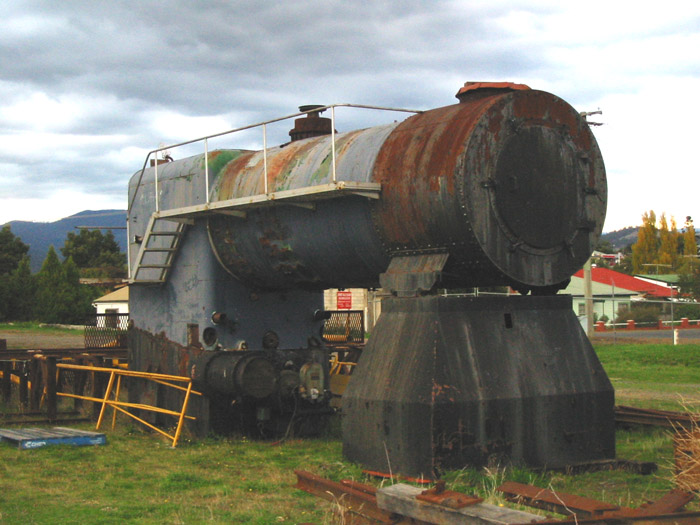
This ASG boiler had been adopted for static use at some
stage.
It is stored by the Derwent Valley Railway at their New
Norfolk depot, as seen above on 30 April 2003.
|
The
Australian Standard Garratt (ASG) was proposed and designed by the
Commonwealth Land Transport Board in 1942 in response to the urgent need for
powerful locomotives for the nation’s 3' 6”-gauge railways during World War 2.
The design team was supervised by the Western Australian Government Railways
(WAGR) Chief Mechanical Engineer Mr. F. Mills - and to the webmaster’s eye, the
ASG bears similarity to his contemporary WAGR S-class 4-8-2 locomotives including
the distinctive boiler cowling. Sixty-five ASG locomotives were authorised
for production with the components assembled at several Australian workshops: Newport Workshops (Vic) - 16 Islington Workshops (SA) - 12 Clyde Engineering (NSW) - 27 Midland Workshops (WA) - 10 The first
ASG locomotives were in steam within 12 months of design starting, reflecting
the wartime emergency conditions in which the class was conceived. They were
immediately put into service with initial success, providing significant
additional motive power for the heavy wartime traffic. However, it seems that
aspects of the design were too rushed as flaws became apparent and in time
the ASGs became very unpopular with crews. Indeed, the ASG locomotives were subject
to strike action and a Royal Commission in WA. Construction ceased in
December 1945 with 57 units assembled and most were destined for relatively
short working lives. ASG
locomotives found use across Australia's 3' 6" gauge railways, with a
number changing ownership for further service after the war years: ·
25 ASG locomotives worked for the Western Australian
Government Railways. These received modifications following the 1945 Royal
Commission but were replaced by the more modern W and V-class steam
locomotives and first-generation diesels, with the last withdrawn in 1957. ·
6 ASG locomotives were acquired from the WAGR by the
South Australian Railways as a stopgap on heavy Cockburn (Broken Hill) - Port
Pirie ore trains, pending the arrival of the 400-class 4-8-2 + 2-8-4
Beyer-Garratts. These ASGs were condemned in early 1956. ·
23 ASG locomotives worked for a time in Queensland but
were quickly withdrawn at the end of World War 2 and spent most of their time
on storage sidings while awaiting a buyer. The excellent history of the
Queensland Garratt and other articulated locomotives ‘Crimson Giants’
includes a poignant series of photographs showing the Queensland ASG
locomotives stored, boarded up and unwanted, at Mayne and Rocklea in the 1946
- 1950 period. Some were later sold to Tasmanian Government Railways, others
to the Emu Bay Railway but the balance were scrapped in the 1950s. One was
scrapped having never turned a wheel. ·
14 ASG locomotives worked for the Tasmanian Government
Railways. One of the
more successful users of the ASG was the privately owned Emu Bay Railway in
Tasmania, which purchased a number and made several improvements.
Interestingly these ASGs replaced three earlier Beyer Peacock 4-8-2 + 2-8-4
locomotives which had been supplied in 1929. All the Tasmanian Government
Railway and Emu Bay Railway ASG locomotives met the scrapper's torch, however
an interesting survivor can be found at the Derwent Valley Railway's New
Norfolk depot in the form of an ASG boiler which had been adopted for static industrial
use. The
Tasmanian Government Railway was in the habit of re-using otherwise redundant
components that could be put to good use, including several ASG water tanks
which were adopted for stationary use as lineside water supplies. Four such
ASG water tanks survive in the care of the Don River Railway. In Western
Australia, an ASG boiler is held at the railway museum at Bassendean, with
another displayed at the Yarloop workshops. It seems that the ASG locos may
not have found much success on the rails, but their boilers were very useful as
stationary steam plant! Adrian
Gunzberg provides a good account of the ASGs in his authorative book ‘A
history of WAGR steam locomotives’. In addition, ‘Crimson Giants’ provides
the ASG story from the Queensland perspective, together with the more
successful Beyer-Peacock 4-8-2 + 2-8-4 locomotives which superseded them (as
represented in preservation by 1009). The only
complete ASG survivor is G 33 which operated at the Fyansford Cement Works in
Victoria and is being restored to operation at the Bellarine Railway at
Queenscliff, Victoria. For more
information about the ASG locomotives, refer to the page for G 33. |
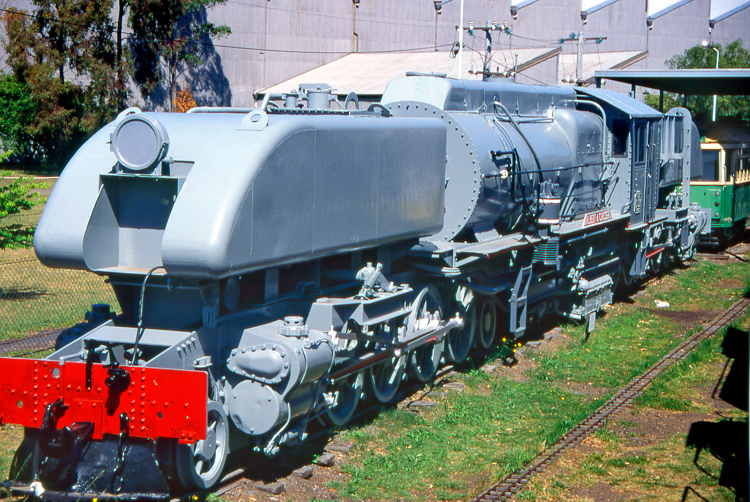
G 33 'Albert A Gunsser' on display at the North
Williamstown railway museum on 4th December 1994.
It appears to have recently been
repainted into the unlined grey livery worn at the Fyansford cement work.
G 33 is now under restoration to operation
at the Bellarine Railway, Queenscliff.
This view was kindly contributed by Tony Bartlett.
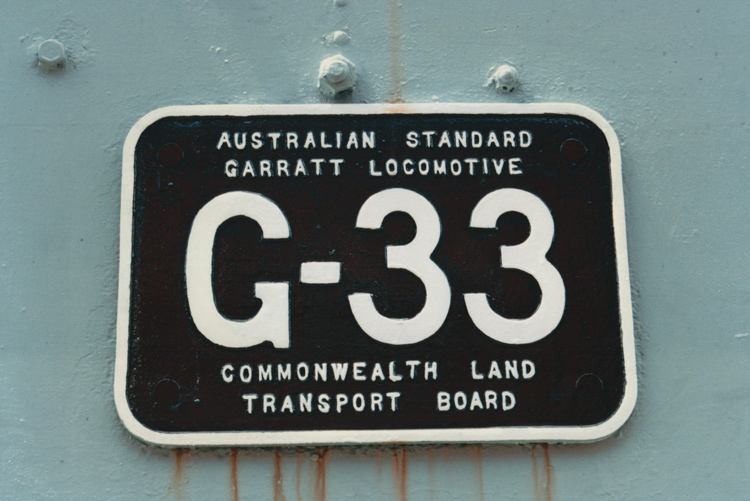
G 33's numberplate shows the Commonwealth Land Transport
Board parentage of the Australian Standard Garratt locomotives.
This scanned photo dates from a period when G 33 was displayed
at North Williamstown in Fyansford grey livery.
References
|
a |
A. Gunzburg
'A history of WAGR steam locomotives', published by
ARHS (Western Australian Division) 1984. |
|
b |
West A. M.,
'Crimson Giants - The Articulated Steam Locomotives of Queensland Rail' published by
the Australian Railway Historical Society, Queensland Division, 1995. |
|
c |
Fluck R.
E., Sampson R., & Bird K. J. 'Steam
locomotives and Railcars of the South Australian Railways', published by
The Mile End Railway Museum (SA) Inc, 1986. |
Page updated: 27 May 2026
|
Government Railways: |
|
|||||||||
|
Private & Industrial Railways: |
|