|
|
5096 Chullora Heritage Hub |
|
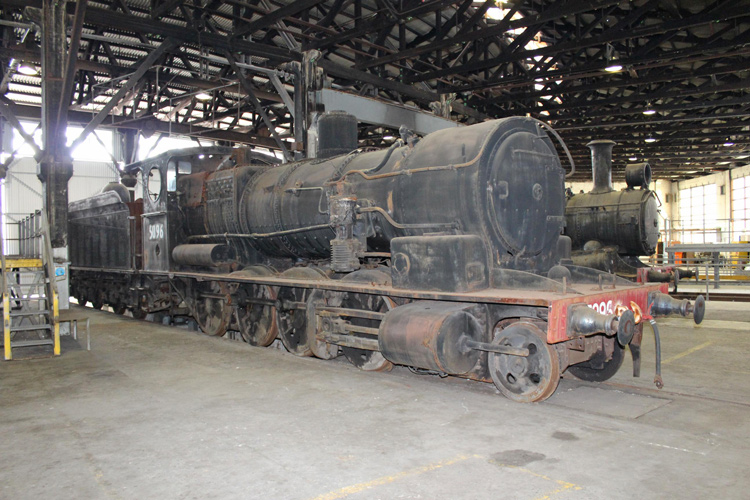
5096 (sans chimney) stored in the Broadmeadow roundhouse on
15 December 2012, with thanks to Jeff Mullier for contributing this photo.
(5096’s chimney was found to be loose during preparation
for rail transfer to Broadmeadow, so it had been removed for safe transport.)
|
Builder |
Granville NSW |
|
Builder’s Number & Year |
1 of 1907 |
|
Wheel Arrangement |
2-8-0 |
|
No. in class |
280 |
|
This
locomotive entered traffic on 6 June 1907 as T 356, one of the highly successful
T(524) class 2-8-0 freight locomotives designed by the New South Wales
Government Railways (NSWGR) in conjunction with Beyer Peacock & Co,
Manchester under the leadership of Chief Mechanical Engineer, William Thow.
The T(524) class grew to number 280 examples following deliveries by several
suppliers, with the design further developed by the NSWGR to the later
TF(939) class (190 examples) and K(1353) class (120 examples) to provide a
total of 590 ‘Standard Goods Locomotives’. The T(524) class were reclassified
as (D)50 class in the 1924 renumbering scheme, with T 356 becoming 5096. (For
more general information about the T(524 / (D)50-class, refer to the page for
preserved loco 5069.) While many
saturated T(524) / (D)50 engines were rebuilt with superheated boilers, 5096
retained its saturated boiler and remained largely unmodified during its
working life. It was withdrawn from NSWGR duties in December 1965 with
2,029,961km of accumulated service and condemned on 17 November 1967 after a
period of use as a static boiler. Fortunately, 5096 was saved for
preservation within the collection of the New South Wales Rail Transport
Museum (NSWRTM), not only as the representative of the T(524) / (D)50 class,
but also in view of being the first locomotive constructed by The Clyde
Engineering Co Ltd, Granville. Clyde Engineering went on to construct several
hundred steam locomotives of various types for the NSWGR and other customers,
including the mighty (D)57-class 4-8-2’s and 3801 among the first five
(C)38-class Pacific locomotives.
Modern diesel-electric locomotives also followed. Many
NSWRTM exhibits were worn and rust-streaked on joining the collection in Enfield No.1
roundhouse, having been in open storage following withdrawal. 5096 was among
these and was displayed in 'as received' condition until the early 1980's,
when the boiler clothing and lagging was removed to prevent further decay of
the boiler barrel. (Various components such as the connecting rods, steam
dome cover and sections of boiler clothing remain stored in the tender coal
space.) Some cosmetic rust removal and repainting was done in 1991. Around
2003 the locomotive was assessed for restoration in the workshop area at
Thirlmere by a group of NSWRTM volunteers, but I understand the boiler barrel
was found to be heavily pitted and requiring replacement. 5096 subsequently
remained stored away from public view. During
August 2008, 5096 was rail hauled from Thirlmere for undercover storage at the
Broadmeadow Locomotive Depot, Newcastle. (At one stage 5096 had been
allocated for display at the Junee Roundhouse Museum but this did not proceed
and 5096 remained stored in the roundhouse at Broadmeadow.) 5096 is
significant not only as the progenitor of many Clyde Engineering built
locomotives, but also representing the development of manufacturing in NSW.
Hopefully resources can be found for its restoration and public viewing in
the future. An
excellent resource for detailed information about this locomotive is the fact sheet for 5096 on the NSW Government Office of
Environment & Heritage website. UPDATE: 5096 was
relocated from Broadmeadow to the Chullora Heritage Hub during February 2024 for further
undercover storage and conservation. Hopefully Chullora will provide a
suitable restoration base for 5096 and other worthy exhibits now stored
there. Superheated
D(50) representative - 5241 As an
aside – I recall a list of locomotives set aside as intended exhibits for the
proposed NSW Rail Transport Museum was published in various editions of Railway
Digest in the late 1960’s & early 1970’s, including most of the exhibits surviving
today, but among them was 5241. This locomotive was built by the North
British Locomotive Co (builder’s number 20602 of 1914) among the final D(50) batch
of 72 machines (5207 to 5280) that were supplied new with superheaters, distinguished
by a longer smokebox and more forward chimney. I imagine 5241 was selected from
the 280 total examples of the D(50) class to represent the design evolution to
include superheating. The loco had travelled 2,016,060 km when condemned in May
1972 at 58 years of age. Alas 5241’s luck ran out after some years of storage
at Enfield and it didn’t make it to Thirlmere, instead falling victim to the site
clean-out and being scrapped in August 1974. The Thirlmere collection ultimately
became rather weighted in favour of express passenger types and it is a pity
that 5241 isn’t there as an example of the freight haulage backbone of the
NSWGR fleet. D(55) class loco 5595 is currently
the only representative at Thirlmere of the 590 Standards Goods locos that
once existed in NSW. A few other superheated D(50) class survived into 1974
including 5132 & 5133 recently retired from Port Waratah, and luckily 5132 was purchased for the Dorrigo Steam
Railway & Museum collection. Perhaps someone has some insight or
background to 5241’s story that can be contributed to this site? |
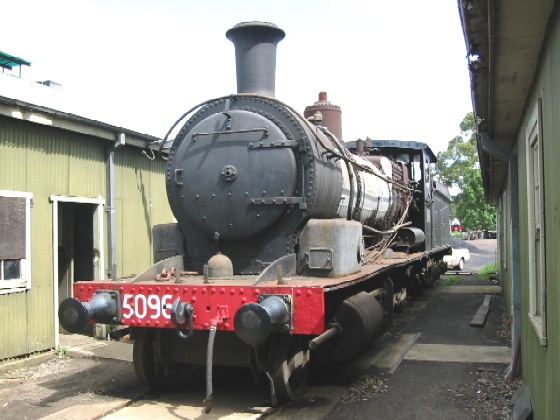
5096 on the Restoration Road in the former workshop area of
the NSWRTM, Thirlmere on 17 March 2003.
At the time it was being assessed for
possible restoration to operation, but the boiler was found to have severe
corrosion pitting.
This area at Thirlmere has since been completely
redeveloped as the entrance hall of the new Trainworks museum.
References
|
a |
‘Standards
in Steam – the 50 Class’ by R. G. Preston, Published
by Eveleigh Press, 1992. |
|
b |
‘A
Compendium of New South Wales Steam Locomotives’ compiled
by Alex Grunbach, published
by the Australian Railway Historical Society, New South
Wales Division, 1989. |
|
c |
‘Steam Locomotive
Data’ July 1974 edition, compiled
by J. H. Forsyth for the Public
Transport Commission of NSW. |
|
d |
Wikipedia
entry for the NSWGR D50 class, retrieved
29 July 2015. |
|
e |
Webmaster's
observation or comment. |
Page updated: 14 July 2026
|
Government Railways: |
|
|||||||||
|
Private & Industrial Railways: |
|