|
|
E 18 NSW Rail Museum, Thirlmere |
|

E(17) class No.18 in the display hall at the NSW Rail
Transport Museum, Thirlmere on 23 November 2008.
Features attesting to the loco’s age
include the ornate chimney, Salter safety valves and a spartan cab.
The large front sandboxes are prominent, and
a smaller sandbox is also positioned above the rear two axles.
(The skylights in the display hall had been upgraded in
2008, which significantly improved exhibit viewing and photography.)
|
Builder |
Newcastle-on-Tyne, England |
|
Builder’s Number & Year |
1542 of 1866 |
|
Wheel Arrangement |
0-6-0 |
|
No. in class |
23 |
|
No.18 was
the second of the ‘E(17)’ class 0-6-0 freight locomotives for the NSW
Government Railways (NSWGR), constructed from 1865 by the famous
Newcastle-on-Tyne builders Robert Stephenson & Co. The E(17) class were
examples of the classic Stephenson ‘long boiler’ 0-6-0 configuration, which
achieved significant increases in boiler efficiency and hence haulage
capacity via a deep firebox hung behind the rear driving axle. Large
sandboxes mounted on the front buffer beam indicate the need for heavy
sanding on steep grades, while also helping to balance the weight of the
firebox and increasing adhesive weight on the driving wheels. The design and
power of these machines attest to their assigned freight duties on the
newly-opened and heavily graded main lines to the South and West of Sydney,
including operations over the Great Western Railway and Lithgow Zig Zag, and
the Great Southern Railway through Picton and Thirlmere to Goulburn. Evidently
satisfied with the performance of these long boiler 0-6-0’s, repeat orders for
further E(17) class machines followed including several constructed by the
local firm Vale & Lacy of Sydney, with the class ultimately numbering 23
locomotives. The design subsequently formed the basis of a successful family
of 0-6-0 locomotives for the NSWGR across several classes:
The E(17) class
were superseded on heavy mountain freight work in the 1880’s when more
powerful British 2-6-0 and American 2-8-0 locomotives had become available.
‘Steam Locomotive Data’ published by the NSWPTC in 1974 provides detailed
records for the NSWGR steam locomotives, showing that most E(17) locomotives
were withdrawn between 1889 and 1892 although many appear to have remained in
storage before being formally condemned and scrapped in 1906. It seems the
class retained usefulness with many sold to industrial concerns, some
continuing in these roles for many decades. Two were sold to the Public Works
Department for construction duties, returning to the NSWGR in 1917 and
surviving long enough to be allocated 1002 and 1003 among the X(10) grouping
of miscellaneous and obsolete locomotives in the 1924 renumbering scheme. No.
42 (Vale & Lacy No. 7 of 1871) was sold in 1903 and remained in
industrial service until 1958 but was unfortunately scrapped the following
year. The sole
surviving member of the class is E 18, withdrawn by the NSW Railways in 1892
and sold to the Southern Coal Company in 1897. This enterprise later became
the Corrimal Coal & Coke Company and retained E 18 in their employment
until as late as 1953. The locomotive was reportedly dismantled for an
overhaul that ultimately did not proceed, with the dismantled components
remaining at Corrimal for some years. Fortunately,
the dismantled E 18 was still in existence when the NSW Rail Transport Museum
(NSWRTM, now known as the NSW Rail Museum) came into being in the early
1960's, based at the former Enfield locomotive depot in Sydney. The veteran
machine was donated for preservation and reassembled for static display,
where it was restored by volunteers and placed on display at the Enfield No.1
Roundhouse in company with other NSWRTM exhibits. There it became one of the
NSWRTM's most significant exhibits, providing a striking contrast with the
museum's later steam and diesel locomotives. Photos
from the 1950’s show E 18 working at Corrimal with its equally ancient
tender, notable for external springing above the frames, however, the
original tender was not preserved and instead the locomotive is now paired with
a B(55) / Z(24) Class tender (Tab 62) dating from 1892. During restoration this
tender had enlarged ‘windows’ cut in to the frame to more closely resemble an
original E(17) Class tender, but the tender frame retains its internal
springing, and the tender tank is wider than those of an E(17) Class. (Tender
Tab 62 takes its identity from the locomotive it was originally allocated to,
B(55) / Z(24) Class loco B 62, later known as No. 460 and ultimately 2408. Coincidentally, this locomotive survives in the
Dorrigo Steam Railway & Museum collection.) Alas, the
NSWRTM had to vacate the Enfield site in 1975 and E 18 was transferred to Thirlmere
together with other exhibits in 1975. It was towed to Thirlmere by diesel 44234
on 24 June 1975 in a fascinating consist of elderly exhibits including locomotives
3085, 2029, 1308, 1033, 1219, 1076 and Emu Gravel No.1. E 18
retains a number of distinctive features characteristic of early locomotives
such as an ornate chimney, polished brass steam dome cover and slender Salter
safety valves. The large sandboxes on the front running plate attest to heavy
freight train duties on the severe 1:33 grades and sharp curves of the early
main line alignments, together with the need to counterweight the firebox. Today E 18
remains a very important exhibit in the NSW Rail Museum collection, given a
proud place within the display hall at the entrance. Access walkways have
been provided into the cab, with the tender separated somewhat from the loco
to expand the footplate area available to visitors. The NSW
Rail Museum is situated alongside the Picton to Mittagong ‘Loop Line’ railway
– once the main line to Albury for interconnection to Melbourne – supporting
a tourist train service for museum visitors. An interesting feature of the Loop
Line route is the steepest sections near Hilltop and Colo Vale that were
subject to railway deviations in 1897 and subsequently adopted as part of the
road alignment to Mittagong. Driving along these sections of road today, one
can appreciate the steep railway grades the E(17) class was designed to
overcome – and imagine E 18 and her sister locomotives working hard up these
grades during the 1860s and 1870s. Similarly, the Lithgow Zig Zag dating from
1869 provides an operating context for these pioneering mountain freight
locomotives. The
Wikipedia page for the E(17)
class provides further technical and historical information for these
significant old locos. |
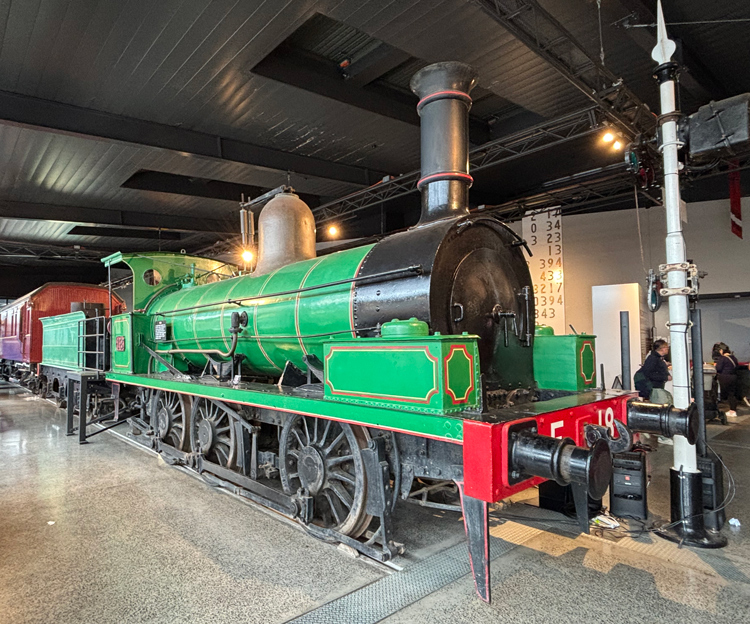
E 18 now have a prominent position in the display hall, as
seen on 17 May 2026.
The tender is somewhat separated to provide improved
visitor access to the cab, accessed via a broad walkway from the left side.
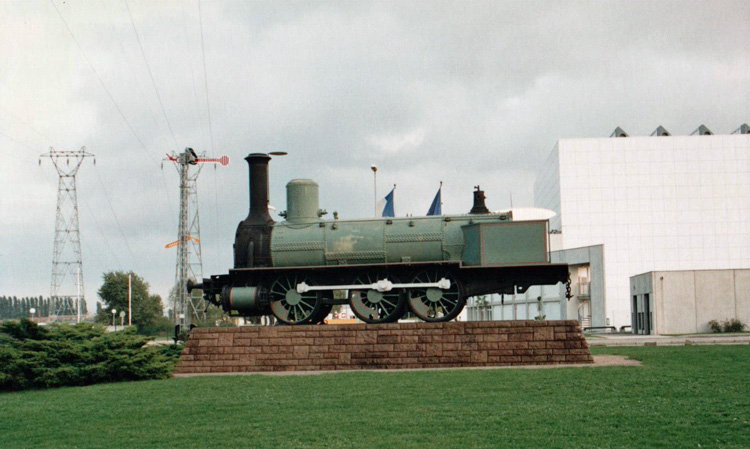
For comparison & interest, here is a view of an elderly
‘long boiler’ locomotive (albeit outside-cylindered and somewhat incomplete)
plinthed outside the French national
railway museum at Mulhouse, France (Cité
du Train) as per my visit of 1994.
The firebox can be seen positioned behind
the rear axle. This locomotive also features a chimney lid (flipped open).
According to Steam
Locomotive Information, this machine was Chemins de fer
Paris-Lyon-Méditerranée (PLM) Railway No. 030 TB 2,
built by P.L.M. Works (Oullins), as B/N
76 of 1870 and hence of similar age to the NSWGR E17 and following 0-6-0
classes.
References
|
a |
Eardley, G. H. 'Locomotives: A Guide - Enfield
Railway Museum', published by the NSWRTM, 1973. |
|
b |
‘A
Compendium of New South Wales Steam Locomotives’ compiled
by Alex Grunbach, published
by the Australian Railway Historical Society, New South
Wales Division, 1989. |
|
c |
‘Steam
Locomotive Data’ July 1974 edition, compiled
by J. H. Forsyth for the Public
Transport Commission of NSW. |
|
d |
Eardley, G. H. 'Locomotives
Beyond Recall', published by the NSWRTM,
1976. |
|
e |
Information
provided by Bruce Saunders via emails dated 17 September and 26 September 2026. |
|
f |
Wikipedia
page for NSW
E17 class, Retrieved 8
November 2026 |
Page updated: 17 November 2026
|
Government Railways: |
|
|||||||||
|
Private & Industrial Railways: |
|
|