|
|
1033 NSW Rail Museum, Thirlmere |
|
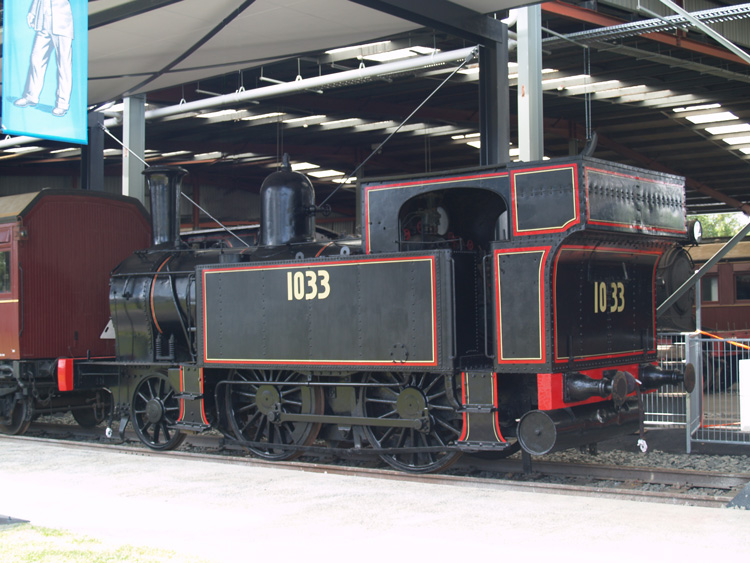
Freshly repainted 1033 on display at the NSW
Rail Museum (then known as ‘Trainworks’) on 6 March 2011.
|
Builder |
Manchester |
|
|
Builder’s Number & Year |
2661 of 1885 |
|
|
Wheel Arrangement |
2-4-0T |
|
|
No. in class |
18 |
|
|
This
locomotive was built by Beyer Peacock & Company under an order for twelve
2-4-0T locomotives for Sydney suburban passenger duties, becoming the New
South Wales Government Railways (NSWGR) F(351) class. These were followed by
a further six locomotives supplied by Sydney manufacturer Henry Vale &
Company, bolstering the class to a total of 18 units. It had originally been
numbered F 355 and received the number 1033 among the ‘X10’ grouping of
miscellaneous and obsolete locomotives & cranes in the NSWGR's 1924
renumbering scheme. The F(351)
class 2-4-0T locomotives followed the design of earlier machines supplied by
Beyer Peacock & Co from 1864 to private railway companies on the Isle of
Wight. The South Australian Railways P-class locomotives (represented by P 117 at the National Railway Museum,
Port Adelaide) were also members of this Beyer Peacock & Co design
family. The F(351)
class were removed from Sydney suburban passenger workings following a fatal
accident at Sydenham in 1901, following which they were relegated to workshop
and depot shunting duties. Ten were sold into industrial service, including F
360 which worked on the Wolgan Valley Railway to Newnes, but none of those
sold to industry survived into preservation. Sister locomotive 1042 was also preserved after finishing
its career as the Cardiff Workshops shunter and is one of the Henry Vale
& Company supplied locomotives. 1033
finished its days as a workshop shunter and mobile steam plant at the NSWGR
Eveleigh Railway Workshops in Sydney. It was statically restored to a high
standard in lined green livery by the NSW Rail Transport Museum and had been
a prime exhibit at the entrance to their Thirlmere site at the 1975 opening.
However subsequent years of open-air display at Thirlmere caused 1033's
paintwork to fade and the polished brasswork to tarnish. Her old boiler
lagging also needed to be professionally removed. 1033 received cosmetic
restoration and repainting to lined black livery in 2011 in time for the
opening of the new ‘Trainworks’ museum at Thirlmere (now the NSW Rail Museum)
and greets visitors as they head into the main exhibition hall. Alex
Grunbach's authoritative book ‘A Compendium of New South Wales Steam
Locomotives’ provides a good history of the F(351) class and disposal details
for those sold into industrial service. Also included is information about
the Sydenham crash of 1901 and subsequent investigation, which struck the
webmaster as interesting reading with modern parallels! Another surviving portion of the F(351) class is the boiler of Junee roundhouse shunter 1036 / Lo 32 ‘Fanny’, which is fitted to locomotive 1076. |
|||
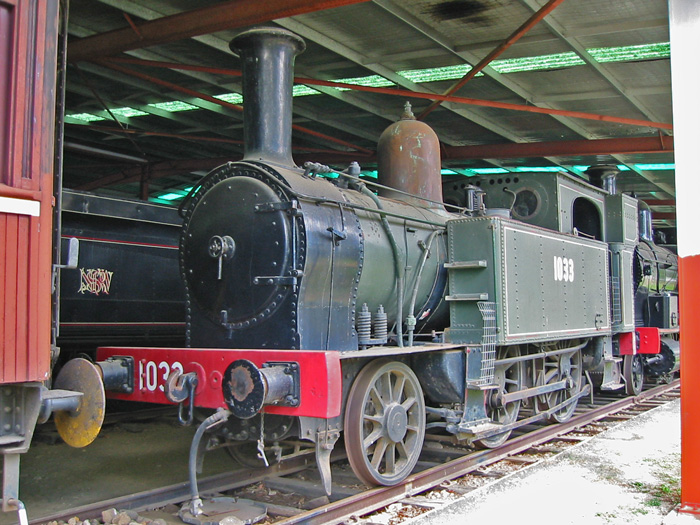
1033 displayed at the NSW Rail Transport Museum, Thirlmere
on 17 March 2003.
1033 wore lined green livery with a polished brass dome
cover, but the paint and brasswork had weathered over the years of display.
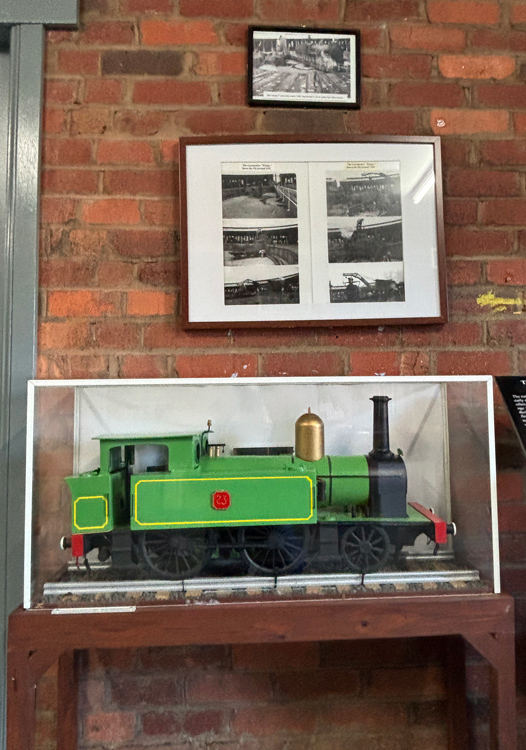
This fine model of 1036 (bearing an earlier number ‘Lo 23’) was seen at Junee Roundhouse Museum on 11 June 2025.
The chimney is of a very
tall, tapered design, possibly as originally delivered.
The photograph display
above the model documents 1036’s infamous excursion into the turntable pit at
Junee!
References
|
a |
‘A
Compendium of New South Wales Steam Locomotives’ compiled by Alex Grunbach,
published by the Australian Railway Historical
Society, New South Wales Division, 1989. pp.85 |
|
b |
‘Steam
Locomotive Data’ July 1974 edition, compiled by J. H. Forsyth for
the Public Transport Commission of NSW. |
|
c |
Webmaster's observation or comment |
Page updated: 13 May 2026
|
Government Railways: |
|
|||||||||
|
Private & Industrial Railways: |
|